
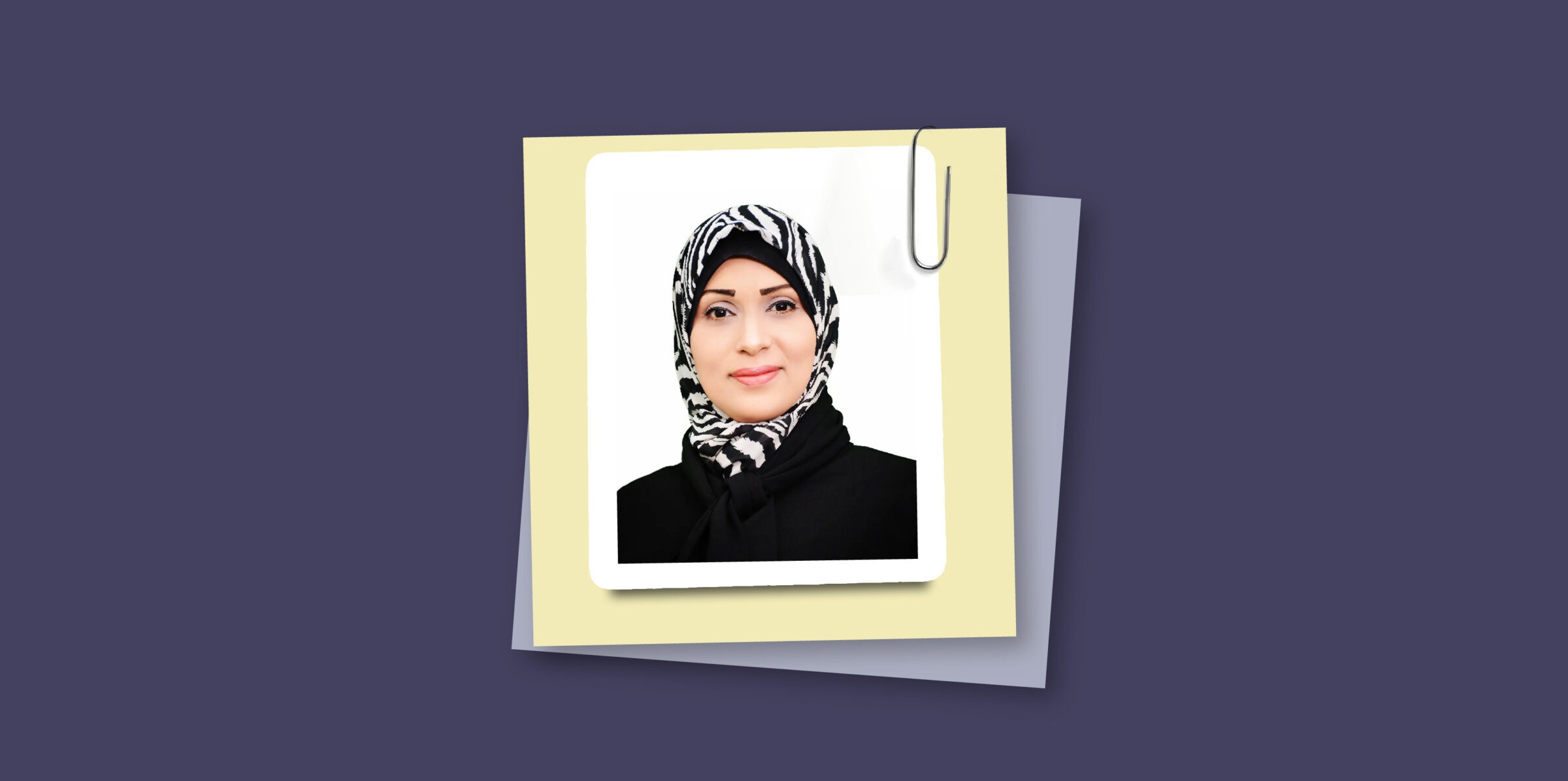
Asmaa Ramadan Mustafa, English Language teacher – Palestine
This interview was conducted amidst the genocidal war on Gaza, with teacher Asmaa Mustafa, who, despite being repeatedly displaced from one location to another, remained steadfast in establishing educational initiatives in every displacement tent she reached. She actively documented and shared her experiences and reflections through the Gaza Blog and various local and international media platforms.
Due to the extreme circumstances, the interview was conducted through written correspondence rather than the recorded video format typically used in Manhajiyat interviews, as such an option was impossible under those circumstances.
Asmaa Mustafa has served as an English language teacher in the Directorate of Education in Northern Gaza for sixteen years. She has been recognized with numerous awards and honors, including the title of Global Teacher in 2020. In addition to her teaching, she is an educational researcher who has published several studies in international journals and is a regular contributor to Manhajiyat magazine.
Let’s start with you, Asmaa: tell us about yourself, the distinguished teacher from Gaza?
Asmaa Ramadan Hassan Mustafa; I have been an English language teacher at the North Gaza Education Directorate for sixteen years now. I won the title of Global Teacher in 2020, one of the best teachers in the world; Palestine’s Creative Teacher for 2022, and Palestine’s First Teacher in the Southern Districts in 2022. I won the first Digital Media Excellence Award in Palestine in 2023, as the best content creator on the Facebook platform. I won the Award of the General Secretariat of the Council of Ministers in Gaza, and the Education Stars Award in 2020, and the Ideal Teacher Award in 2019.
I am a Microsoft Certified Educator since 2020. I am also a National Geographic Certified Educator for 2020, and a team member of the National Geographic Exploring Minds in Education since 2021. I am a Google Certified Educator for 2020, and an Apple Certified Educator for 2020. I am a team member of the Digital Empowerment in Education at the Ministry of Education in Gaza since 2020, and an ambassador for the “Wakelet” platform for education in Palestine.
I spoke in 48 international and local conferences in many universities around the world, and participated in many Learning Days in national universities. I also participated as a speaker in many educational seminars, and was a guest in many sessions conducted by inspiring teachers who are my colleagues in the profession in the Gaza Strip. I was a guest on television programs inside and outside the country, to transfer my experience to colleagues in the profession.
I wrote a book about my experience in teaching English through a fun and active learning method; it is a guide for teachers and parents to teach English through games to non-native speakers. During the Covid-19 pandemic era, I laid down the foundations for teaching in virtual classrooms in another book I entitled “The Golden Rules for Managing Virtual Classrooms”. I am currently writing my third book, entitled “Journeys Around the World to Teach English: A Unique Approach to Learning English Through Practice and Application.”
I am the Group Director of the Gaza English Coffee eTwinning project group, which is a distant learning project to teach the English language for free, to girls in marginalized areas in the Gaza Strip.
I broke the siege imposed on our students in the Gaza Strip using the eTwinning method. Through this method, I conduct educational tours with my students via Zoom, Skype and Google Meet. We connect two classes with a camera, one in Gaza and the other in another country. And each of us can speak to the others in English about our identity, culture, honorable history and the geography of the Canaanite Palestine since the beginning of creation. And we correct the world’s concepts about Palestine, and we introduce the world to the Nazi occupation, and we raise our flag and olive branch in front of the students of the outside world. And we also listen to them; we listen to their culture and civilization, and we visit a different country every week . Until now, the number of countries we have visited is 68 countries through 400 global virtual meetings. Love and peace unite us every time we meet.
I am a part of the Pen Palestine project, and the Hands Up project, and the BBC Live Classes project for teaching English to non-native speakers, and the World Peace Song project for teaching English through singing to non-native speakers.
I am a Pedagogy researcher; I published several research papers in an international journal. I am also a writer for a methodology magazine, and a partner with you towards contemporary Arab education.
We are honored to have you. Can you explain to us where you are now, and the journey that brought you here?
On the morning of October 7, 2023, I woke up to the sounds of war drums. I was about to leave the house to go to work. I carried in my extra bag a Palestinian flag, an olive branch that I had picked from the garden, and an embroidered Palestinian dress; my students had to present the morning broadcast while wearing traditional Palestinian clothing. All of that ended as soon as the Ministry of Education in Gaza announced the suspension of school until further notice. I started following the local and international news, but things were not going well. I expected that the price of the war on Gaza this time would be high, but I did not expect that our suffering would last for five and a half months until now, and the nightmare has not ended yet. This is the first time that my estimation was wrong. My wait for a Sunday morning, when I can resume school and resume my life was so long, and it has not come yet.
After three bitter days, on the morning of the fourth day, I prepared a cup of tea and was just holding it in my hand, when I heard our neighbors shouting as high as they could: “Mustafa family! get out! evacuate the building, the towers next to us will be bombed.” There are twelve apartments in our residential building, inhabited by more than eighty people. And we were hosting relatives who had been displaced from the far north of the Gaza Strip, next to the borders. And there are newly built residential towers surrounding our neighborhood.
I left everything, put on my hijab and went out with my mother leaning on my shoulder. We quickly got out unaware of anything. Our next-door neighbor received us, and after a few minutes I went out to look for my two daughters. I found my older brother looking for me to take me to my daughters. Soon, he took us to the house of another neighbor, a little further away. Mothers who were searching for their children started screaming because they learned that their children perished while they were crossing the street. Their bodies were under the rubble of our neighbors’ house, which was targeted at that moment. The intended place was never targeted. More than thirty civilians fell victim to this crime, who were a short time ago safe and secure in their homes or just passing by. I could hardly believe what happened. My trembling heart told me that, this time, death would pursue everyone, and that no one would escape the bombarded areas.
As of that moment, we decided to move to a friend’s house that was further away from the towers that the enemy intended to destroy, according to what he had told us. We spent four days and nights there. On the last night, at exactly one o’clock in the morning, we heard the neighbors coming out of their homes and shouting: “Quickly, get out! the entire residential block is being targeted, go to the UNRWA schools.” The anguish was getting worse and worse, and death was chasing me everywhere. I quickly hugged my two daughters, carried them up, and we hurried to the nearest UNRWA school, looking for safety. I don’t know where I got the strength to carry the two girls, and at the same time run quickly towards the intended location. Everyone around me was running, the screaming was intense, also the fear. Perhaps it was what my grandmother who used to talk about: “the last breath”. We arrived at three in the morning, and there, I literally lay on the ground in the schoolyard with nothing above me and my family’s heads except the sky. My memory took me back to when I used to come to this school to pick up my daughters, and to thank their teachers for their performance and good manners. I was here on Tuesday morning, a few days before the war, dropping off my daughters at school. I cried bitterly all night, feeling that this war will last longer than ever, taking with it our places where our beautiful memories are. It was a hard night. With the sunrise, I went out looking for some water in a nearby house to perform the rituals before praying my prayers that I had missed the day before. From there, we went to the house of a friend and a neighbor near our house. Feeling relatively warm, we spent five days as their guests. The stress intensified once again. Every day we would wake up and see large parts of our neighborhood totally destroyed. We were in a great danger, so decided to leave.
On the morning of the twelfth day of the war, I went with my younger brother to our beautiful house. The moment I entered, I felt an unbelievable emotional comfort. I entered my small room and carried everything that was light and expensive, and I put a few clothes in a bag. I said to myself: “In a few days we will be back, God willing.” I looked at the place for the last time, then I heard my brother calling me, “Come on, Asma, we don’t want to stay long.” I told him that I am ready, then I glanced at a cup of tea that I had prepared for myself before escaping but never tasted it… I cried silently and left.
What was the destination of the new displacement?
We said goodbye to northern Gaza with tears. Our hearts were weeping, but our eyes kept our tears from falling. We tried to hold ourselves together all the way. Silence prevailed, only to be interrupted by our sighs. The streets were demolished and many of the buildings had collapsed. The extent of destruction was vast, although it was only the twelfth day of the war! We headed to the center of the Gaza Strip, south of Wadi Gaza, where our friends were waiting for us. On the way, I passed by the school where I work; I stopped the taxi and brought my laptop from there, and we continued our way. We went through the destroyed streets of Gaza and saw what was unbearable; Gaza is dying day after day.
We spent eighteen days in the Nuseirat camp, in the middle of the Gaza Strip. The aerial strikes and artillery shelling did not stop for a single moment; I am not exaggerating. One of the nights there, at exactly 9:30, I was the only one who had not slept yet because I was listening to the news on my mobile, hoping to hear about something that would promise the end of the tragedy we are living in. Suddenly, a pile of broken burnt stones fell on our heads, and gunpowder dust covered the entire room. Some shrapnel from the bombs fell here and there and shattered the windows, and their glass rained down on our heads. We breathed the dust while running away from the place. We couldn’t see each other. Everyone survived, thank God, but we were not well. There were five children in our room, and we thought one of them had died, because he was not responding to our calls. But, by the grace of God Almighty, he took a sudden gasp after our attempts to revive him, and he woke up crying. I looked out the window at the destroyed house and saw the remains of the martyrs’ bodies nearby. And people were rushing to help and save whoever they could help. It was as if I lost my consciousness for a moment; I feared that I was living the horrors of the Day of Judgment. When I gradually regained consciousness, I began helping the injured people around. More than fifteen martyrs were killed that night, most of them are children and women. May God have mercy on them all. As soon as the sun rose, we moved again to Al-Fakhari School, northeast of Rafah, near the European Hospital. My older brother received us there, and we stayed in the school library for two full months. The airstrikes and shelling were intense there, also the place was extremely overcrowded with people. Most of the displaced families experienced many problems because the place was so packed, and it was very noisy. We were distressed because of the situation at the UNRWA schools in the southern Gaza Strip, not to mention the lack of privacy which we badly needed, but it was impossible to have.
The school library was a shelter for more than seven families. And deadly epidemics started to spread around, as it was impossible to keep the place clean for a long time. We never felt comfortable or safe there, and we were forced to move again to the far southwest of Rafah, where the Philadelphi Corridor separates the Gaza Strip from Egypt. We prepared a small tent in which thirteen members of my family would live, anticipating our imminent return to our house that we left in northern Gaza. We were still holding in our hands the keys to that house, filled with hope, mixed with regret for what happened to us.
You went through many wars before this one. How did you, as teachers, used to deal with them?
With every military conflict the Gaza Strip used to witness, the teachers worked hard to provide what they can to their students. It was possible to do something real in the field of education during those times. I, like the other teachers, would turn to the virtual classroom during any conflict, in order to check on my students and reassure them. Then, I would follow up with them, as much as I could. I would review the previous lessons, help my students acquire certain skills, or support the talents that I did not have time for inside the regular classroom. I wouldn’t let my students surrender to despair or frustration or fear or sadness. I would meet them via the Google Meet application, through which we can open the camera and talk directly about “synchronous e-learning”. We would also listen to each other at intermittent periods during the days of the week, depending on the students’ circumstances and the times that suit them. However, no war lasted for more than fifty days, except this Nazi war that we are living through now. It was possible to activate virtual classes and communicate with the students. But this is impossible to implement in the circumstances we are living in now, as we are witnessing a complete interruption of all communications in the Gaza Strip, including internet services.
In previous wars, I used to leave my house with a team of volunteers to go to the homes of some students and give them stationery and training materials for the English course. I was doing that in case a student was unable to obtain a cell phone, which meant at that time that she won’t be able to finish her lessons and complete the course. But now, no one can do that. If anything, the priority is now for water, food and firewood. Because we need them to cook whatever food the displaced can find in their tents and provide something for their children.
Tell us about your students before the war: what were their ambitions and dreams? And how did the siege of Gaza affect those dreams?
I always use the word “my daughters” to refer to my students. They really are. In the sixteen years I have been an English teacher, I never imagined that our dreams would be shattered like this. It is the most difficult time we have ever lived through. My daughters have so many dreams and ambitions, and each one has her own way to achieve her dream. One of them wishes to become a doctor, and she said: “I want to become a doctor, Miss, and come visit you and tell people that she is my teacher and I am her daughter. I want to treat the bleeding wounds of Palestine.” Another one wants to study architecture; it’s where she finds herself, as she is talented in art and drawing. She once told me: “I want to make amazing houses for the people of Gaza. I want to design houses that will make the whole world come and see them.” One of them wishes to study abroad, and she said: “I want to become an ambassador for Palestine, and invite you to visit the country that I will be in.” Another one is planning to study law, so she said to me: “I want to defend women, Miss, and get them their rights.”
One of them dreams of starting a small business, so she told me: “I want to open a beauty salon, Miss, and I will fix your hair for free.” Another one learned to cook from her mother, so she said: “In the future, if I have enough money, I want to start a pastry business and sell pastry on demand. But for you, Miss, it’s going to be for free.” Another one loves children, so she said: “I will become a kindergarten teacher and I will play with children all day long.” Another girl is a fashion design enthusiast, so she explains to me what she would be designing: “I want to work on designs that you would like, and I will design clothes for you, Miss.” Another one wishes to study graphic design, as she loves the art of design and photo editing, so she said: “I want to open a studio, so you can bring your daughters, Miss, and I will take their photos.” One of my students wants to work in real estate, because her family has long history in this field. Many of them dream of starting a happy family and raising their children and preparing them for a better future in Palestine: “We won’t have many children, so we can raise them well, like you told us, Miss.” One of them dreams of becoming an English teacher like her teacher, and she really struck a chord in my heart. She loved the subject because of “her great love for her teacher”, she said.
Simple dreams that were actually nothing more than our own rights, but they were scattered and dispersed. The winds blew against our wishes, and now, we only think of safety and how to protect ourselves from the Zionist warplanes and treacherous tank shells. How to protect our children from the danger of death. How to feed them and warm them from the harsh winter cold, from destruction, killing, torture, bombing, genocide, execution and starvation. My daughters think about making a dough, and how the air current is blowing to enable them to start a fire and cook it. This is what the family was able to get after a day’s toil. And they might not have something to cook for a long time. Our dreams turned into a life in a tent, thinking about how we will spare our children the heat of the sun, “God’s blazing fire” during the day, and the harsh cold’s “deadly frost” at night. We are now working hard to treat our children from hepatitis and influenza. How can we spare them the danger of deadly, rapidly spreading epidemics? How can we heal our deep wounds when our hearts are exhausted with pain, oppression and death? How can we bear this burden? And until when?
There, on the edge of the road, between our tents, a woman stared at me from afar. Then she approached me and threw herself on my shoulder and cried bitterly. I felt she was going to fall to the ground. She said to me, after making sure that I remembered her: “The three of them are gone, Miss. All my children are gone. I wish I was gone with them to be set free”. She was one of my students. She graduated from university and opened a successful engineering office, because people believed in her work. She lost her children, her home, her project, and her future in a blink of an eye. Her dream now is to join her children. I asked God to comfort her heart and strengthen her with patience. I told her as I used to tell her before: “Stay strong, champion.” I smiled a shy smile smothered by indescribable pain. I said goodbye to her, holding her hand tightly, wiping away her tears and entrusting her to God. There is no savior for us but Him.
Some people remained steadfast and holding on in northern Gaza, dreaming of a piece of bread to feed their children. But for us, our dreams were cut short because we were displaced from Gaza. Yet, some have their dreams moving with them from one place to another. We carry them in our hearts as we carry our important documents on our shoulders. And we take them with us to any place we think of moving to, simply because it is likely to be safer.
Our ultimate wish, is for the killing and death machine to stop in Gaza; Gaza, the cemetery of invaders. We still wish for life to return as it was before, despite our complete conviction that the extent of destruction is very enormous, and nothing will ever return to what it was.
Our wishes and prayers are ascending to heaven every day; that God will have mercy on us with His vast mercy and take care of us in this world and the hereafter. For He, glory be to Him, is more merciful on us than we are on ourselves. He is our Master and we have no master but Him.
This war is different in its brutality, how did you deal with it as a teacher?
The Middle East has not witnessed a war as brutal as this in decades. It took everything from us except our hope in God alone. The education sector was almost completely destroyed, and interrupting the education process began from the first day of the war on Gaza. I had created a virtual classroom via Google Classroom, as I do every year. I was doing my usual daily work, which was taking pictures of the contents on the board and transferring them to the students and their families via the virtual classroom. I was also enriching the lessons with some videos, illustrated stories, or any content that would enrich the lessons in any way.
On Saturday morning, October 7th, I received many questions in the virtual classroom about school attendance. That was the focus of our conversation on the first day. As of the second day, we started corresponding via the virtual classroom to check on each other’s safety. I did not expect that martyrs from my students would fall during the first week, and more of them in the second week of the war. At that time, communication was completely cut off in northern Gaza, and I was displaced to the center of Gaza Strip on the twelfth day. I left the north, and behind me were many martyrs and wounded from my students, who perished with their entire families. I was unable to check on my students, even virtually, for a long time. I managed to connect to the Internet in Nuseirat on the thirty-fourth day, and I wish I had not. I read the news of the martyrdom of more than twenty students. Nour, Fida, Maryam, and Jamila from the same class, were all martyred. They always sat together, and none of the teachers could separate them. They passed away to God on one day. What a difficult news! And what a harsh moment to receive such horrific news! Then, Taroub sent me a message after a month of losing contact with her; she said: “I am fine, my girls. Thank God, I left the house a few moments before they bombarded it.”
After a period of time, communication was gradually cut off, and my students would not be able to send me a message and tell me their news. As for me, I hold on to God and beseech Him more than ever not to lose more people. My prayer every day is: “Oh God, do not let me see any of those whom I love hurt. Oh God, protect them wherever they are.” This, in short, is the situation of my virtual class in this war.
Did the war stop you from being the “teacher”?
Absolutely not. No force in the world can stop me from doing my duty towards my daughters. I will remain a teacher for the children of Gaza as long as I live. But during the war, things have become more difficult. You couldn’t look at a face in the devastated Gaza without feeling sad. I make a great effort to remain strong in front of the students, while performing my duty as a teacher during the war on Gaza.
In the beginning, I was displaced to one of the schools in the south. The library there was full of beautiful stories and books. I read all the stories and classified them according to their suitability for different age groups. I formed a group of fifteen children, and I agreed with them to meet at the entrance of the library, which was inhabited by more than seventy individuals. We would sit in a circle, with me in the middle telling a new story every day. The news spread, and the number of male and female students who attended daily at three in the afternoon reached more than fifty. I decided to divide them into groups, and the matter became more organized, which allowed other numbers of children to join in. Instead of the students coming to me, I would go to them, and visit every part of the building where they lived, until I’d completed my tour on all the classrooms, which became the new homes of the displaced. I would tell them a story every day and discuss the lessons learned, aiming to teach them a life value that would enhance the children’s behavior, and sometimes reassure them and take them away, even for a short time, from the deadly conditions of war. I was working on improving their morale and moving them from a state of guilt to a relatively better state. I would give gifts to 10 children every day, in order to motivate and encourage them to attend and interact. We would often do some recreational activity together, such as throwing a ball, singing a song, or playing the fisherman’s game…
This continued for more than two months in the shelter school, until I was forced to move again to the “tent” in the far southwest of Rafah city; far from the remnants of the Zionist war machine and the enemy’s artillery that were getting closer to our place of displacement day after day. I went and left behind people I love, and who love me. I got used to meeting them with their smiles, and I became close to their mothers. I wished that, from that shelter, we would return to northern Gaza. But life did not turn out the way we wanted. My consolation was that, the mothers there had mastered this method with their children.
Did the tent hinder your determination as a teacher?
I am in this tent since I was displaced, beginning of 2024. And around me more than two hundred thousand tents, where hundreds of thousands of children of different age groups live, most of them are between five and ten years of age. Their time is meaningless and their lives are wasted. I look closely at each one of them, and smile at him and hide the regret in my heart. I have always believed that smiling is the key to communication between us, so I can talk to them. These children live the most difficult days of their lives, and most of them have reached the point of not wanting to talk at all. It took two weeks until I was able to established with them the relationship between a teacher and her students; better yet, a relationship between a mother and her children. I drew myself close to them so that I could tell them a story every day to give them a life lesson. A story to teach them a useful principle and value, which they would tell it to their families and relatives inside the tent. I would take the initiative to greet them and get to know their families, especially their mothers, in order to build a bridge of social communication between us. So, I was able to form a homogeneous group of children of similar age, to provide them with what they had been deprived of for four months, as much as possible.
With the passing of time, I became friends with more than one hundred and fifty children. All of them had their own stories of oppression and pain, which they would tell to us when we met on a small hill in the open air. Then, I would tell them a quiet story that would take them to a different world than ours; a world where there is no killing, death or destruction. And I could feel the children’s passion when listening to my story; I would notice on their faces a feeling of some happiness and hope.
Before each meeting with my students, I prepare in advance like I am going to teach a lesson in the classroom. And I prepare the questions for the discussion after the storytelling. And we distribute gifts to the children who participate in the discussion and provide the correct answers.
It went further beyond that. I have now a wonderful team of parents who listen to my stories every day. Some girls were willing to participate in the storytelling just like me. Some did debriefing exercises, some fathers brought us toys, some took charge of running competitions, and they were all there for me the whole time. I told stories, we played, we drew, we raced, and we got to know each other better.
Here, love and hope unite us, between our tents that are extremely hot during the day and extremely cold at night, small in size and untidy. Suffering unites us and the bitterness of loss unites us. Our pains are similar and we always agree in our love of life, if we can find a way to it.
From the rubble, we emerged thousands of times and survived and succeeded in rebuilding the human being in us and rehabilitating it for life. We succeeded in shaking off the dust of pain and oppression by comforting each other and listening to each other, reassuring each other that, what is coming for all of us is more beautiful than what has passed, and that war may make us different people who love Gaza more, love Palestine more, and defend it.
The greatest outcome of a teacher’s work is the love of her students, and when they consider her their role model and ask about her in her absence. I did not know that our situation in Gaza would reach the same level of displacement, loss, and destruction that we are experiencing today. This makes me think a thousand times about how I can help others as much as I can. How I can ease their pain and suffering, invest in their minds and hearts, and help their families deal with their children during the war on Gaza. This war is tearing us apart and completely destroying our homes and schools. We are now looking for a place to shelter ourselves, not a teacher to teach our children. A fierce war has taken everything from us except the hope that I see, as clear as the sun, in the eyes of our young children every time we gather in the tent classroom.
What about your classmates from your old school or the displacement school, what are they doing?
If you only knew how we were torn apart, if only you knew! All our worries piled against us at once. First, the connection was cut for long periods of times in all of the Gaza Strip. This made it impossible for individuals to communicate. We suffer greatly from ongoing sudden telecom disconnections in some areas within the Gaza Strip, but not in the other areas. We can’t make a call, we are no able to connect to the internet. Not to mention the complete power outage in the Gaza Strip for five and a half months, to the point that it is difficult for us to recharge our phones, if it wasn’t for the solar energy technique.
We had a school that used to gather us at 7am every morning. Last time we met was on Thursday morning, October 5th. We never met again after that, except in some sporadic social media meetings, whenever the service was available.
Little did we know that the staff group on WhatsApp – which I had previously created for me and my colleagues and for the school principal to communicate outside the working hours – would one day become the only thread of connection between us. When the war broke out, we used to communicate every day, reassuring each other and asking about each other’s conditions. However, the internet connection in northern Gaza was soon cut off. I later learned that many of my colleagues had been displaced to the central and southern parts of the Strip, just like me. Also, I learned, from the group and some voice calls I was able to make, that our former school principal was martyred along with her entire family. And the secretary, Ms. Nora, faced the same fate. Our colleague, Diaa Al-Shams, and our school’s supervisor were also martyred. I later learned that most of my colleagues had lost their homes and were left with nothing. Some of those who were not displaced from northern Gaza, were suffering the consequences of famine. I learned that many of them lost one or two children or more. Some of them became widows after losing their husbands, and some registered their sons among the missing ones. Some even were injured and or had their body parts amputated.
Such is the case of the afflicted teachers in Gaza. The difficult circumstances and bitter conditions we live in may prevent a teacher from offering anything to those around him, especially when she is displaced in a tent or living in a classroom, in a shelter school. Or if she is very lucky, living in the home of relatives in the southern Gaza Strip. Whenever a teacher sends me a message, I immediately reply: “Thank God you are fine.” This is my way of knowing who among of my colleagues survived the war.
There are the shelter schools. I followed up the news of some individual attempts from a very small group of teachers to teach children beneficial things in these difficult days, despite the scarcity of resources, or rather, their complete absence as is the case in the tents of displacement. These attempts generally aim to make use of this time and fill it with what can benefit the child. And the educational sessions are not without entertaining and debriefing exercises that are very necessary in these circumstances. That, in addition to many simple recreational activities carried out by some activists who belong to institutions that are supported financially, because they are funded to perform these tasks inside the sheltering schools or between the tents.
If you can reach out to the teachers of the world, what would you say to them?
I will tell the world’s teachers stories of excellence and heroism from the heart of Gaza. I will tell the world about the unwavering teachers of Gaza who are enduring despite their great affliction. I will tell the world about the teachers of the Gaza Strip, who are still working and taking the initiative, out of love and spirit of volunteerism, for the sake of the children of their homeland. I will tell the world about our work despite the complete lack of capabilities, the absence of infrastructure, and the complete absence of any role of the educational body. I will tell the world about our hope to be a school that teaches the world’s teachers about the principles of true education in all its forms, including communal education in shelters, between tents, over the hills, and on the sands of the desert.
Good teachers of the world, you must all pay attention to the educational and pedagogical situation that has been damaged to the core by the war on Gaza. Performing your duty and responding to the call of your colleagues in all of the educational institutions to fix what can be fixed in the coming stage, is evidence of the ongoing cooperation between us, which was built on the foundations of the Nakba and peace over the past years.
If the war stopped today, what do you think should be done on the educational level, despite the enormity of the other needs?
I hope the war would really stop today before tomorrow. The educational sector has had enough of destruction, and it suffered from the abuse of children, teachers and environment. Despite the enormity of the other humanitarian needs in general, the education is still one of the top priorities in Gaza, especially once the war ends. The system with all its educational institutions in Gaza must be immediately risen to rebuild the students, and to prepare the Palestinian children for education. Also, it should be taken into consideration the specificity of this phase and its compelling needs upon the students, the teachers, the curriculum, and the educational environment as a whole.
The formation of age-homogeneous groups of children must be considered. Also, appointed locations must be provided for them to receive their education, as an alternative to schools that have been completely destroyed, or even to schools that have been transformed into shelters for displaced people, who won’t have another shelter after the war.
The educational content must also be reconsidered to suit this phase and its circumstances. A new content should be formed that is specific to the post-war period, which may extend for at least six months. The student’s needs must be studied in relation to what the war has left on their psyche and behavior, and its impact on their mental and emotional side. This should lead to a new curriculum for a transitional period that works on bringing the child back to the normal situation; so that education can resume after this stage.
Moreover, it is necessary to train teachers and prepare them for the next stage and beyond, so that they are able to perform their duties in a satisfactory way.
What are the dreams of Asmaa the person, the mother, and the teacher?
I dream… and dreams are forbidden here, and there is no time nor place for dreaming in Gaza after October the 7th. I dream of a peaceful life for everyone, filled with love and peace. I dream of returning soon to our homes that we left behind. Our hearts aching with pain for what was left behind there. I dream of returning and living like the rest of the world, in peace and security.
Asmaa, the mother, dreams of a better life for her two daughters than her own. She prays to God every moment to save the two apples of her eyes, Sarah and Sondos, with which she sees the beauty of life, away from the Zionist war machine. She also prays to God to comfort the heart of every mother whose child was martyred; she prays for every Palestinian child to live in peace, security and freedom.
As for Asmaa, the teacher, her heart was aching as she followed the news of her daughters whom she had met at the beginning of this school year, and those who graduated from her school during the past fifteen years. She hopes that the dreams of all her students will come true, and that she will actually get to meet the ones who became doctors, engineers, teachers, graphic designers, fashion designers… and that, as a teacher, she will remain worthy of her daughters’ trust.
Our dreams and our children’s dreams have all died. What we dream about now, is to obtain the most basic of our rights as human beings. We dream that Sunday morning, October 8, will come in peace. We dream that this dark cloud will dissipate, and that peace and security will prevail in our country and in the Islamic countries everywhere.
Gaza will win and will return, because life and Gaza are inseparable. When you return to your students/daughters, what will you be teaching them? Will you be comfortable to teach them imported values that they will read anew?
I hear you say, “when you return”, and my heart burns in me. I really don’t know where to start; I don’t know if I will be one of those who would return to life or leave it early. Many feelings flooded me when I read this question. I imagine, for a moment, I am standing in front of my students again. oh God, make this happen soon! Here I am dreaming again! However, I am certain that Gaza will return to life, and that life will return to it. It will even become a more beautiful bride than before. I am reminded of something that the late great Palestinian Mahmoud Darwish had said, which speaks about one of the secrets of the Palestinian people with an exceptional flavor. The meaning of what he said can only be grasped by those who lived in the heart of Gaza, or love it. He said: “And we love life whenever we can find a way to it.” Yes, this afflicted Gaza is the cemetery of invaders; it is too resistant to be broken.
The whole world learned how to love life from the enduring, steadfast people of Gaza. Because Gaza is giving the world lessons in action, not just in words; lessons of endurance, resilience, and the love of land and country.
I yearn to be back to my students in the same classroom, and to see them rushing to greet in the corridor and help me carrying my educational tools and the chalk box. I miss their welcoming smiles that fill the world with beauty, and fills me with a happiness that I cannot describe in words. I miss greeting back my students, and hear them welcoming me together in one voice. I miss checking on those who are present, and asking about those who are absent. I miss the pronunciation lesson, and using the mirror to explain it to them. I would carry forty small mirrors, so they could master the pronunciation of words, and I would hear my students’ laughter and see their faces expressing joy. I miss teaching conversations through the global twinning educational program; we’d talk, listen, and sing the anthem of peace: “We are brothers and sisters, we are one family”.
I miss the details, such as decorating the walls of our classroom and decorating the school tables. I miss the opening day, when the school principal calls us to get together around one dining table, so we can taste the various kinds of dishes that we made with our own hands, and each student can invite her colleague to share a homemade meal with her.
Yes, God willing, we will return one day, and hopefully soon. We will return, confident in God Almighty that we are able to complete the journey. But we know that the road has become more rugged and much more difficult. And we know that the war has rearranged the priorities of education: firstly, for the teachers, secondly, for the educational system, and thirdly, for the students’ families.
Our determination will fill the universe with peace and love for the whole world. From Gaza, the land of peace, which has never seen peace, we will send our greetings to the peace-loving peoples, and we will continue to teach the correct principles and values that our true religion has called us to. We will remain as brothers and sisters to all who stood by us and supported us in our times of trouble.
Yes, I will continue to teach my daughters the Islamic values and principles, and the universal values that do not conflict with them. In Gaza, we will always be the peace-loving people, despite being let down by so many, locally and internationally. But we’re never forsaken by the mercy of God. And despite the bitterness of what we are suffering alone, yes, I will remain as selective as I have been throughout my career in education. I am well aware of what I teach, and I will remain a tribune to educate my daughters about everything that has happened and is happening around them. They are the mothers of tomorrow and the leaders of the future, and we have great hope in them.
This interview was published in issue 16 of Manhajiyat magazine and was translated into English as part of a joint project with the Centre for Lebanese Studies and (PROCOL). All rights reserved. Republishing or quoting the article is prohibited without citing the source or obtaining written permission.