Education in Times of War: An Act of Life
About
You can download the book in PDF format here.
The academy is not paradise. But learning is a place where paradise can be created. The classroom, with all its limitations, remains a location of possibility. In that field of possibility we have the opportunity to labor for freedom, to demand of ourselves and our comrades, an openness of mind and heart that allows us to face reality even as we collectively imagine ways to move beyond boundaries, to transgress. This is education as the practice of freedom.
bell hooks, 1994 p. 207
Yet what does education become when schools are reduced to mass graves, when classrooms exist only as fragments in the rubble, when teachers must be not just educators but shields against despair, architects of hope in a world intent on their erasure? This book is an act of witness, a refusal of silence. It gathers the voices of educators in Occupied Palestine, in Gaza under siege and annihilation, in the West Bank under occupation, and in Lebanon under continuous attacks. Educators who have taught, comforted, and resisted amid one of the most brutal occupations of our time. Their words, raw and unflinching, cut through the sanitised discourse of the academic field “Education in Crisis and Conflict,” a field debated in the hushed halls of academia and the sanitised conference rooms of international NGOs, far from the sound of explosions and the smell of blood. This book seeks to challenge the prevailing orthodoxy in academia, which has largely embraced the dominant, oppressive logic of the funding agencies and institutions that created and continue to benefit from the field, often without questioning the ontological and epistemological foundations that sustain this domination.
For the past twenty-five years, the field of education in conflict and post conflict has expanded rapidly, shaped by the relentless churn of global wars and humanitarian crises. Yet its growth has been dictated by the priorities of donors, the technical technocrats, and the logic of liberal peacebuilding, a framework more concerned with stability than justice, with management than liberation. Under the banner of “neutrality,” it has reduced education to a technical intervention, a delivery of services measured in toolkits, standardised curricula, and minimum standards. It speaks of “resilience” while ignoring the structures that force communities to be resilient in the first place. It promotes “peace education” while sidestepping the occupation, the apartheid, the genocide that make peace impossible.
The machinery of this system is vast and self-sustaining. International NGOs, UN agencies, and research institutions, largely headquartered in the Global North, design programmes, allocate funds, and produce knowledge with little accountability to the communities they claim to serve. Local organisations, once rooted in grassroots resistance, are transformed into service providers and subcontractors for large INGOs. Their labour is extracted to fulfil the reporting requirements of Global North bureaucracies and narrow definitions of accountability. The language of “capacity building” often promoted by these INGOs masks a deeper erosion: the dismantling of autonomous struggle, the co-optation of resistance into the metrics of humanitarian aid.
And then came Gaza. In the face of a live-streamed genocide, the entire infrastructure of “education in conflict” revealed its hollowness. Humanitarian agencies, petrified by the risk of losing funding, hesitated to name the slaughter. UNRWA, the backbone of Palestinian education, was defunded and demonised as its schools were bombed and its staff systematically killed. Networks that claimed to represent the educational and academic communities choked on their own silence, unable even to mourn their own colleagues. The myth of neutrality collapsed under the weight of its own hypocrisy, exposing a truth long known but rarely spoken that this system was never neutral. It was built by the same powers that arm the oppressor, that veto ceasefires, that turn classrooms into targets.
Academia, too, stood complicit. Scholars who built careers studying Palestine and Lebanon suddenly had nothing to say. Universities, under pressure from donors and governments, silenced dissent. Research ethics, narrowly defined by institutional review boards, became a shield for cowardice, as if ethics ended with data collection and did not extend to solidarity with the people whose suffering filled footnotes and funded grants. Suddenly academia went back to the age of positivism and the distant and disconnected role scholars must have towards their ‘subject of study’, thus laying bare its moral bankruptcy. For all its theories, it had no answer to the most urgent question: what is the responsibility of knowledge amid genocide and colonialism?
This book is an answer to that failure. It attempts to challenge the arrogance of academia in what it calls as valid academic knowledge or labels as theory, often only an entitlement of academia from the Global North, while dismissing other knowledges, rooted in lived experience, resistance, and survival, as unworthy, relegated to the shadows as ‘grey literature’ and less intellectual. This book aims to challenge this hierarchy by centring the voices of Palestinian educators not as subjects of study but as theorists of their own struggle. To cite bell hooks again, “I find theoretical talk-to be most meaningful when it invites readers to engage in critical reflection and to engage in the practice… To me, this theory emerges from the concrete, from my efforts to make sense of everyday life experiences, from my efforts to intervene critically in my life and the lives of others. … Theory is not inherently healing, liberatory, or revolutionary. lt fulfils this function only when we ask that it do so and direct our theorsing towards this end (1994, p.70)”. In the field of education in conflict, its time to question our theories.
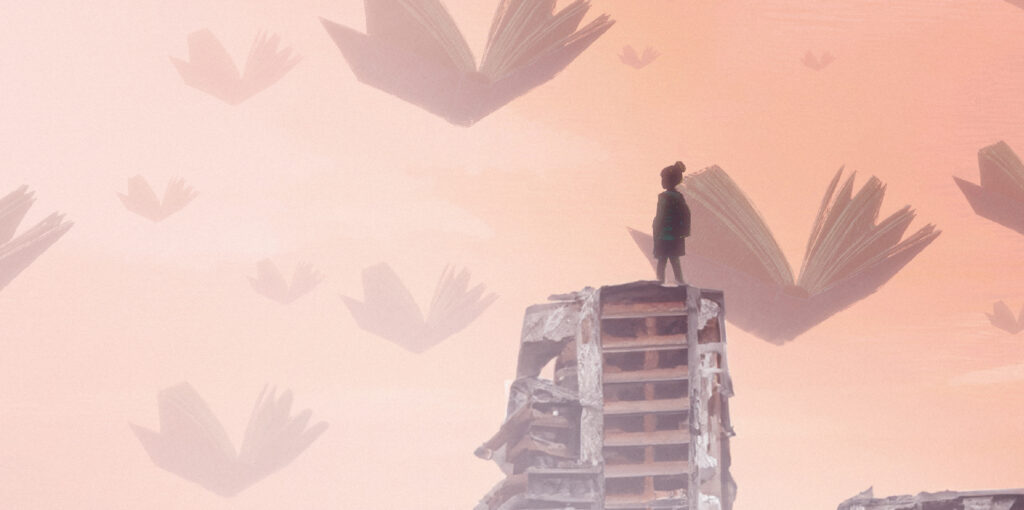
In Gaza, where every university has been destroyed, where over 18,000 children have been killed and thousands more are missing and while more than 400 teachers have been killed, education has not stopped. It happens in tents, in the ruins of bombed-out homes, in the spaces between survival and mourning. Teachers have become healers, chroniclers, keepers of memory and catalysts of hope.
“What is education in war?” asks a teacher in Rafah. “It is the act of insisting there will be a future, even when the present is on fire.” This is not education as preparation for life. This is education as life itself: fragile, relentless, unyielding. It is a refusal to let the logic of the oppressor define the boundaries of the possible. The children of Gaza do not need peace education programmes to teach them about justice; they live it in the absence of justice. They do not need trauma interventions to name their pain; they need the world to stop inflicting it and asking them to die quietly. The implications from this book on the field of education in conflict are clear. The field of education in conflict must be rebuilt not as an extension of the humanitarian industrial complex, but as a site of radical solidarity. It must listen to the teachers in these pages, who have written their own curriculum in blood and defiance. It must reject the fiction of neutrality in genocide. It must recognise that research, if it is to have any meaning, must be accountable to the communities it seeks to learn from.
The voices in this book do not ask for pity; they demand justice and accountability. They remind us that education, at its core, is not about systems or syllabi but about the most fundamental of human rights: the right to live, imagine, to question, to exist and resist. While global humanitarian agencies quietly downgrade education from “essential” to “secondary” amid budget cuts, Gaza tells a different story. Here, under bombs and blockade, education has become not just a right, but a lifeline, a way to outlive erasure, to defy the logic of annihilation.
“Here, a teacher is like a doctor – both seek out pain and lay their hands upon it. One heals a nation, while the other restores hope, one soul at a time.” (See chapter below, Palestinian teacher Maisoon Abu Mousa)
This book is the result of a collaboration between the Centre for Lebanese Studies and Manhajiyat aimed to accentuate the voices of teachers educating children amid a deviating war. The collection has been produced by Manhajiyat in Arabic as part of its sixteenth issue, entitled “التعليــم فــي زمــن الحــرب” “Education in times of war”, which also includes content from “مدوّّنــة غــزّّة ” “The Gaza blog” a platform launched by Manhajiyat at the onset of the war on Gaza. It brings together powerful testimonies and critical reflections from educators navigating the realities of war and displacement across Palestine and Lebanon.
This volume opens with Manar Zraiy’s account of the emotional toll and communication challenges faced by teachers striving to ensure their students’ safety amidst bombardment. Shubair, PhD, through his text, seeks to rethink the concept of learning in times of war by tracing the pathways of experiential and non-formal learning that have emerged in Gaza despite the destruction. He aims to show how adversity has transformed into an alternative learning environment, carrying students’ daily questions into unconventional spaces of knowledge. Asma Mustafa offers a moving portrayal of how Gaza’s war-torn streets have become classrooms of resilience, followed by Sherehan Bakron’s deeply personal narrative that frames the school as a second home both a site of joy and profound loss. Maisoon Abu Mousa speaks of return and remembrance, evoking the persistent hope of reclaiming spaces of learning.
An interview with Asma Mustafa provides further insight into the lived educational experience under siege. Jala Rizeq explores the foundations of safe and supportive learning environments during conflict, while Rola Koubeissy and Geneviève Audet interrogate the emotional limits of teaching in crisis and question how hope can be sustained when educators themselves falter. Shadi Ammari addresses the often unseen psychological wounds carried by children in war, advocating for targeted interventions rooted in care and sensitivity.
Mohammed Tayseer Alzoubi offers a framework for building responsive and flexible curricula that can adapt to the instability of conflict zones. Jumana Kharoufeh Hazboun focuses on practical strategies for supporting children scarred by trauma, while Shubair, PhD, discusses how the specter of war, once it began to loom over the small strip of land in Gaza, confronted Palestinian children and students with a torrent of new and unfamiliar terms and concepts, which forced their way into a vocabulary already saturated with the language of pain, suffering, and oppression. Nora Merhi, PhD, reflects on the impossible questions teachers face when war erupts in the middle of a school day. Finally, Yasmine Hassan examines the layered struggles of displacement and the systemic barriers confronting refugee learners in host countries.
Collectively, these contributions reframe education not merely as a casualty of war, but as a frontline of resistance, care, and radical imagination.
Maha Shuayb, PhD. Centre for Lebanese Studies
Learn More
Acknowledgments
We would like to thank all the contributors whose texts and insights form the heart of this collection. Special thanks to Sara Mohammad, Zeina Khoury, Marwan Hassan, Samia Bishara, Yousri Al Amir, Meghri Shammassian, Walid El Houri, Rachel Saliba, Mai Abu Mogly, Maha Shuayb, Bader Othman and all those whose support, feedback, and engagement made this book possible. This book is the result of a collaboration between Manhajiyat and the Centre for Lebanese Studies (CLS) to amplify the voices of educators in Palestine and Lebanon. It emerges from many conversations, reflections, and acts of sharing, and we are deeply grateful for the trust and generosity of everyone involved.
We also acknowledge the support of PROCOL, University College London (UCL) and REAL Centre, who helped bring this project to fruition.
Disclaimer
The views and opinions expressed in this book are those of the individual authors and do not necessarily reflect those of the editors or publishers. The material originally appeared in previous Mahajiyyat issues and blogs and have been edited and translated for clarity and cohesion. Every effort has been made to ensure proper attribution and accuracy at the time of publication.
Table of Contents
How do they let us know that they are okay this time? – Manar Zraiy
Schools might be closed but learning persists – Mohamed Shuber, PhD
Gaza’s schools are closed. But here’s what we learned in the school of war – Asma Mustafa
“School is your second home” – a lesson I lived with joy and pain – Sherehan Bakron
We will return one day… and indeed, we have returned – Maisoon Abu Mous
Interview with Asma Mustafa
What is safe and supportive learning during war? – Jala Rizeq, PhD
Education in context of crisis: “How can students be given hope when teachers lose it?” Rola Koubeissy, PhD | Geneviève Audet, PhD
Psychological interventions for children’s invisible wounds in wars – Shadi Ammari
A flexible and responsive curriculum for teachers – Mohammed Tayseer Alzoubi
Strategies for dealing with children who have been affected by the trauma of war – Jumana Kharoufeh Hazboun
New terms invade the Palestinian Student Dictionary under Israeli aggression – Mohammed Shuber, PhD
Teaching on the day of the war: what should we do? – Nora Merhi, PhD
Displacement and loss of educational opportunities: Challenges of supporting displaced students in host countries – Yasmine Hassan
Articles and blog posts in this dossier were published on the Manhajiyat and translated into English as part of a joint project with the Centre for Lebanese Studies and (PROCOL). All rights reserved. Republishing or quoting the article is prohibited without citing the source or obtaining written permission.